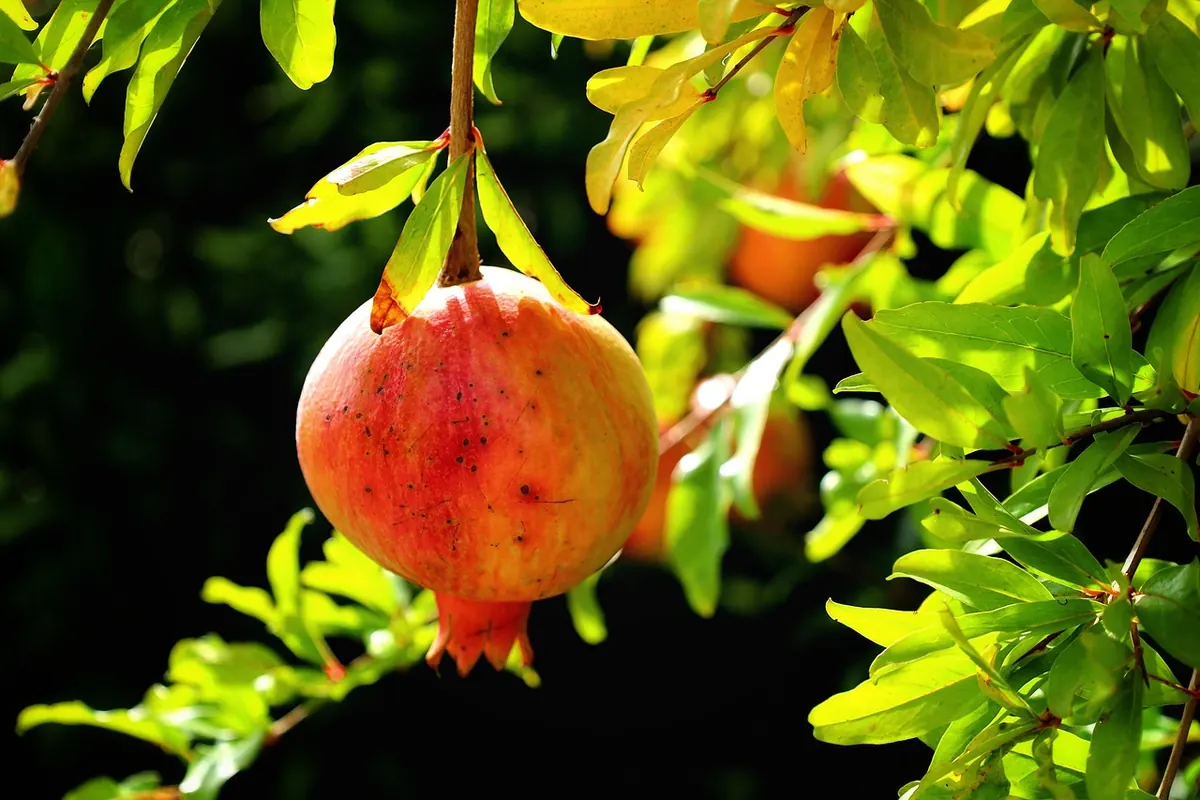
Pomegranates are forgiving plants, which is exactly why so many of them are pruned badly. Left alone, a tree throws up a thicket of stems from the base, crowds its own centre until the middle goes bare and grey, then snaps a limb the first time it carries a heavy crop. Pruned with a little thought, the same tree opens up, dries faster after rain, and holds its fruit on wood strong enough to bear it. The cuts themselves are not complicated. What matters is knowing which wood carries flowers, and having the patience to spread big changes over several winters instead of one.
How a Pomegranate Grows, and Why That Changes Your Cuts
Start with the plant's natural habit. A pomegranate is not really a tree in the apple sense; it is a large shrub that suckers freely from the roots and the base of the trunk, and it wants to grow as a cluster of stems rather than a single leader. Its wood is also brittle, especially where two branches meet at a narrow angle. Those two facts explain most of the pruning decisions you will make.
Fruiting is the other half of the story. Pomegranates flower on current-season growth that emerges from one-year-old wood and from older short spurs. In plain terms, the wood you leave this winter is where next summer's flowers come from. That is why hard, aggressive dormant pruning so often costs a season of fruit: you are cutting off the spurs that would have bloomed. Light and regular beats drastic almost every time. The useful exception is renewal — pomegranates shoot back strongly from old wood, so an ancient, tangled specimen can be rebuilt if you are willing to take two or three years over it.
Choosing the Shape: Single Trunk or Multi-Stem
Before you make a cut, decide what you are growing. The multi-stemmed form is closer to nature and usually the better choice for a garden: three to five well-spaced stems rising from the base in a loose goblet, wide angles between them, nothing crowded in the middle. It establishes quickly, tolerates cold damage to one stem because the others survive, and is simple to renew one trunk at a time.
A single-trunk standard is neater, easier to mow and cultivate around, and gives cleaner fruit, but it takes more work. You will be rubbing out suckers for years, and if the trunk is damaged you lose the whole tree. Choose it for a formal setting or a tight space, not because it is easier.
The First Three Years: Structure Before Fruit
Young trees get shaped, not thinned. Your aim is a frame of strong, widely angled branches; fruit is a bonus in these years, not the target.
- At planting, cut the main stem or stems back to roughly 60–70 cm above the ground, just above a healthy bud. This feels brutal on a new tree and it is exactly what forces side shoots to break low down, where you want them.
- First summer, watch what emerges. Keep three to five shoots spaced around the stem with wide angles, and remove the rest while they are still soft enough to rub off with a thumb. Leave a couple of spares for a season in case one breaks.
- First winter, shorten the chosen stems by about a quarter to a third, cutting to an outward-facing bud. That directs growth outward rather than into the centre.
- Second and third winters, remove anything dead, broken, crossing, rubbing, or growing sharply inward. Take out narrow-crotch forks now, while the wood is small enough for secateurs; a narrow fork on a mature pomegranate is a future split.
Keep your knife in your pocket and your saw in the shed during these years. Tipping every branch in sight removes the flowering spurs you have spent three years building.
Airflow, Light and Fruiting on Established Trees
Once the frame is set, pruning becomes mostly about light and air. An open centre lets sun reach the inner branches, which improves colour and ripening, and it lets wind and sun dry the canopy quickly after rain — the simplest defence against the fungal problems that plague pomegranates in humid climates.
Work in this order: dead and damaged wood first, then suckers at the base, then branches that cross or grow straight back into the middle, then the weak, twiggy growth in shaded parts of the interior. On a tree that is growing too vigorously and fruiting poorly, short tip cuts on strong young shoots encourage new flowering wood the following season.
One caution: do not over-thin. Pomegranate fruit left suddenly exposed after a heavy thinning can scald in strong sun, and bare branches are prone to sunburn too. Leave some interior cover, and avoid removing more than about a quarter of the canopy in a single year.
Renewal Cuts for Old and Neglected Trees
An overgrown pomegranate is usually a mass of grey stems with fruit only at the outside. The good news is that it responds well to renovation, provided you resist doing it all at once. Spread the work over two or three winters and you keep some crop each year while the new wood builds.
- Clear the obvious first. Dead, broken, diseased and rubbing branches come out before anything else. It is remarkable how much better a tree looks after this alone.
- Take out the oldest trunks at ground level. Choose one or two of the thickest, darkest, least productive stems and remove them cleanly at the base. Next winter, take another one or two. New shoots will rise to replace them — select the strongest and train them as the next generation.
- Thin the interior. Remove crowded growth and the tangle of weak twigs in the shaded middle so light reaches the remaining branches.
- Reduce long, leggy limbs to a side branch rather than stubbing them off. A drop-crotch cut to a healthy outward shoot keeps the tree's shape and avoids a burst of weak regrowth.
- Leave a few low shoots on the sunny side for a season if the trunk is suddenly exposed. They shade the bark and can be trained later or removed once the canopy fills in.
If a tree is truly beyond saving — hollow, split, or fruiting only on a few ragged tips — the last resort is to cut it back hard to around 50–60 cm and rebuild from the new shoots. It works, but you will wait two or three years for a real crop.
A Simple Annual Routine
Prune in late winter, once the worst frosts have passed and before the buds break; in cold areas, a cut made too early invites dieback. You need three tools: sharp bypass secateurs, loppers for anything thicker than your thumb, and a pruning saw for old wood. Clean the blades between trees, and make each cut cleanly just outside the swollen collar where the branch joins the stem — no stubs, no flush cuts, and no wound paint.
Then walk the tree once more before you put the tools away. Look for a goblet shape, an open middle, strong wide angles, and a good mix of young and older wood. If it looks slightly under-pruned, that is about right for a pomegranate. Pinch out suckers through summer while they are soft, and leave the rest alone until next winter.
Photo: Tho-Ge / Pixabay