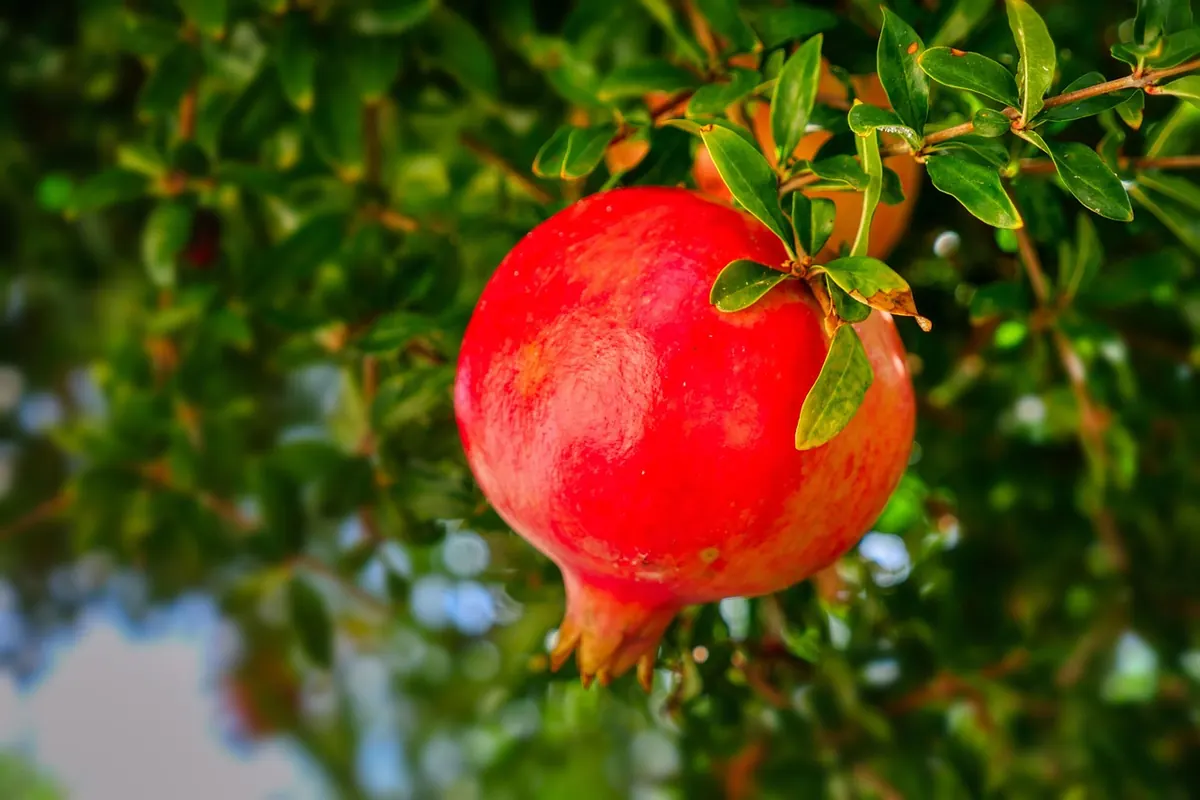
Most pomegranates are shrubs that want to become small trees. Give one a sunny corner and enough time and it will reach three or four metres, arching over the path and dropping fruit on the paving. That picture is what puts people off planting one in a courtyard or a narrow back garden. The useful news is that pomegranates take pruning better than most fruiting plants, they crop well in containers, and a small group of cultivars stays genuinely compact without heroics with the secateurs.
What follows compares eight of them on the things that decide whether a plant works in a limited space: eventual size, how much pruning it asks for, cold and heat tolerance, and whether the fruit is worth eating or mainly decorative.
What "Compact" Really Means With Pomegranates
Nursery labels are optimistic. A plant sold as "compact" may be a true dwarf that never tops a metre and a half, or a vigorous cultivar that can be held at two metres with annual attention. Both can work in a small garden, but they demand different things from you.
- True dwarfs ('Nana', 'Chico'): roughly 1–1.5 m, fine foliage, generous flowers, small fruit. Ornament first, kitchen second.
- Naturally compact fruit types ('Provence', 'Kazake'): 2–3 m if left alone, comfortable at 2 m with light pruning.
- Vigorous but responsive ('Parfianka', 'Sirenevyi'): 3–4 m untended, but they fruit on short spurs along older wood and can be kept at 2–2.5 m without losing the crop.
- Own-root versus grafted: own-root plants can regrow from the base after a hard freeze; grafted ones usually cannot. In cold areas, ask before you buy.
One more point in the pomegranate's favour: it is self-fertile. A single plant in a small garden will set fruit on its own, so you are not obliged to find room for a pollinator.
The Dwarf Ornamentals: 'Nana' and 'Chico'
'Nana'
The classic dwarf pomegranate, grown for two centuries as much for its looks as its crop. It makes a twiggy shrub around 1–1.5 m with narrow glossy leaves and a long summer of single scarlet flowers. The fruit are small, roughly 5–6 cm, with hard seeds and a sharp, acidic juice — fine for a garnish or a sharp jelly, not for eating by the spoonful.
Where it earns its place is in a pot on a sunny terrace, as a low informal hedge, or in the tightest corner of a courtyard. It handles drought and neglect well, though it fruits and flowers far better with regular summer water. In cold winters it may die back to the ground and regrow; established plants usually flower again the following season.
'Chico'
Even smaller, often under a metre, with double orange flowers that look almost like carnations. It sets few fruit and needs a hot, sheltered spot to ripen them. Treat 'Chico' as a flowering shrub for a container you can move under cover in winter, and you will not be disappointed. Treat it as a cropping plant and you probably will.
Fruit-First Compacts: 'Provence' and 'Eversweet'
'Provence'
An old French garden variety with pink-flushed fruit, seeds soft enough to chew and a sweet-tart balance that suits fresh eating. Its real advantage in a small garden is that it ripens in less heat than the desert types, which makes it the sensible pick for a warm wall in a cooler climate. Habit is compact and slightly spreading, so give it width as well as height when you plan the space.
'Eversweet'
Pale-skinned, mild and soft-seeded, with the unusual quality of being pleasant to eat even before it is fully ripe — useful in a short season, where you may be picking before autumn closes in. It flowers over a long period and ripens gradually rather than in one glut. The plant is moderately vigorous, so in a small garden prune for structure each winter and keep it to around 2 m.
Flavour-Led Choices: 'Parfianka' and 'Sirenevyi'
'Parfianka'
If taste is the priority and you have heat to spare, this is the one. Deep red fruit, very soft seeds, and an aromatic, wine-like sweetness that puts most supermarket fruit to shame. It is vigorous, so it suits a large pot better than a narrow border: restricted roots do some of the size-limiting for you, and annual winter pruning does the rest. In cool summers it may not ripen reliably.
'Sirenevyi'
A Russian selection with an unusual violet-pink rind and soft, sweet-tart seeds. Vigour is moderate, the plant is ornamental enough to sit in a mixed border, and it comes from the cold-hardy breeding line, so it winters better than the Mediterranean varieties. Ripens mid-season.
Cold-Hardy Compacts: 'Ariana' and 'Kazake'
'Ariana'
Ukrainian-bred, with red-blushed fruit of good size and a balanced sweet-tart flavour. Reports on hardiness vary with the source and with how well the wood ripens in summer, but this group is generally reckoned a zone or two tougher than the Mediterranean types. In a sheltered spot it is a reasonable gamble in zone 7; growers in zone 6 often succeed with a thick winter mulch and a wall behind the plant.
'Kazake'
The most compact of the cold-hardy group, with medium fruit and a tangy juice that is better in the glass than off the spoon. It crops young, stays manageable in a 30–40 litre pot, and recovers well from dieback. For a small, cold garden where fruit matters more than ornament, it is the safest of the eight.
Matching a Variety to Your Space
- Measure the sun, not just the soil. Pomegranates need six hours of direct summer sun to ripen fruit; without it, choose an ornamental dwarf and enjoy the flowers.
- Decide what you actually want. Flowers and autumn colour: 'Nana' or 'Chico'. Fruit for the kitchen: 'Provence', 'Eversweet' or 'Kazake'.
- Think in pots if the ground is tight. A 30–40 litre container with gritty, free-draining compost keeps any of these to roughly two metres and lets you move it against a warm wall.
- Be honest about winter cold. The Ukrainian and Russian selections are the sensible first choices anywhere frosts bite; the softer Mediterranean types need a sheltered spot.
Practical Notes Before You Buy
Plant in spring where possible, in free-draining soil, and water deeply but infrequently once established — pomegranates resent sitting wet in winter far more than they mind summer drought. Uneven watering as fruit swell is the usual cause of split skins. Feed container plants with a high-potash fertiliser from flowering until harvest, and top-dress with compost in spring.
Prune in late winter, before growth starts. Open the centre of the shrub, remove crossing and damaged branches, and take out a few of the oldest stems at the base to encourage young wood. Avoid heavy tip-pruning: you would be cutting off the short spurs that carry the flowers. Expect little fruit in the first two or three seasons while the plant settles in, then a steady increase.
Finally, ask the nursery whether the plant is own-root and how old it is. A cutting-grown plant two years old will fruit far sooner than a seedling, and in a small garden, where every plant has to earn its square metre, that matters more than the label on the pot.
Photo: fietzfotos / Pixabay